Tuesday, 12 June 2018

BHUTAN DIARIES - Trek to TAKTSANG PALPHUG or TIGER'S NEST (April 2017)

Mountains and the Sacred

Mountains loom large in any landscape and have long been invested with sacredness by many people around the world. The presumption is that the divine or some supernatural or spiritual force is manifesting itself to the beholder, who feels privileged thereby. 
Mountains and the Sacred - A close view of Tiger's Nest
or Taktsang Pahphug

THE BEST VIEWS COME AFTER THE HARDEST CLIMB!!

These could be some inspirational sayings that could explain why sacred sanctuaries exist so far up in the mountains. Looks like they are built almost halfway between the HEAVEN and the EARTH.
Mountains and the Sacred - Somewhere between
Heaven and Earth
A HIKE TO TIGER'S NEST - a challenge for some and a pilgrimage for others is an essential part and one of the MAIN HIGHLIGHTS of any visit to Bhutan.

TIGER'S NEST or TAKTSANG PALPHUG - THE LEGEND

Legend has it that PADMASAMBHAVA also known as GURU RINPOCHE or 'PRECIOUS MASTER' or 'SECOND BUDDHA' arrived in the Himalayas in Bhutan on the back of a flying tigress, that before being reborn and transformed, was his disciple. 

An Image of Guru Rinpoche or the
Second Buddha
Guru Rinpoche had flown from TIBET to tame a mountain tiger demon who lived in the darkness inside the caves around PARO VALLEY. After he succeeded and the demon was tamed, he consecrated the caves and turned them into shrines where he meditated for years and spread Buddhism to the Bhutanese in the following decades. One of these caves, located in a towering cliff 10000 feet above sea level and 3000 feet from the valley floor, is the TAKTSANG PALPHUG Monastery, or the TIGER's NEST. It is thought the Devotees motivated to keep the legend alive, built this CASTLE IN THE AIR in 1692. Visitors report that due to humidity in the surrounding area, the monastery is mostly shrouded by mist or is covered by tiny clouds floating above, giving the temple an even more ethereal and surreal look. It was a favorite refuge for local monks and Buddhists, and by the look of it, this should come as no surprise. Visitors can gain access to this gorgeous 17th century Buddhist temple solely by foot. The climb is a very long and steep path up the Himalayan cliffside but definitely a doable one. On the plus side, the atmosphere is fabulous, the view over the Paro Valley is gorgeous and the many small cave shrines that are now a part of the temple complex definitely provide the patience and the strength to those who wish to reach the cliff hanging TAKTSANG PALPHUG. 
As you can see the Uphill climb is immediate and ahead of me you can
see some people using the mule to trek up...
I had been postponing my Bhutan Visit as I had done Ladakh twice before this and had seen many Monasteries as part of my earlier visits to other places too and so Bhutan didn't appeal to me for quite sometime. But I love trekking and it was the Tiger's Nest trek which caught my fancy and I finally decided to do the Bhutan Trip and I am glad that I did it because the serenity of this trek overwhelms you in many ways especially towards the last part. 
And there I am with part of my group already
on the way up to Taktsang....
One needs to be fit enough to do the entire trek by foot though one can rent a horse till a little above the half-way mark, beyond which, even horses can't climb and so the only option is by foot. Personally I would rate this as a 'Moderate' trek.

A quick early breakfast done at the hotel, we reached the Tiger's Nest entry point by 7:45 am and started our trek by 8 am. One has to purchase entry tickets at the BASE. One can also take walking sticks on rent from the Base. Make sure to carry enough water to keep yourself hydrated for anywhere between 4-6 hours (estimated trek time) and possibly more depending on one's fitness. 
Take your pick and start right away....
On the trek trail...
ANYONE CAN DO THIS TREK...
There is no limitation on anyone doing this trek and our group had the best mix of people ranging from an 11 year old to an 82 year old who completed the trek as well and was a great inspiration to all of us in the group. As the saying goes "WHERE THERE IS A WILL, THERE IS A WAY".
And there you can see the 82 year old member from our group slowly
 making his way up...what an inspiration
Beginning at the base of the PARO valley, the trail winds its way through a forest of deciduous trees and one can see beautiful rhododendrons along the way especially during spring. The uphill climb is immediate with periodical jagged stone steps along the way and also inclined dirt slopes. You are enveloped by trees providing the needed shade. Somewhere halfway along the way, you get the first glimpse of the monastery and you can feel the excitement rising within. 
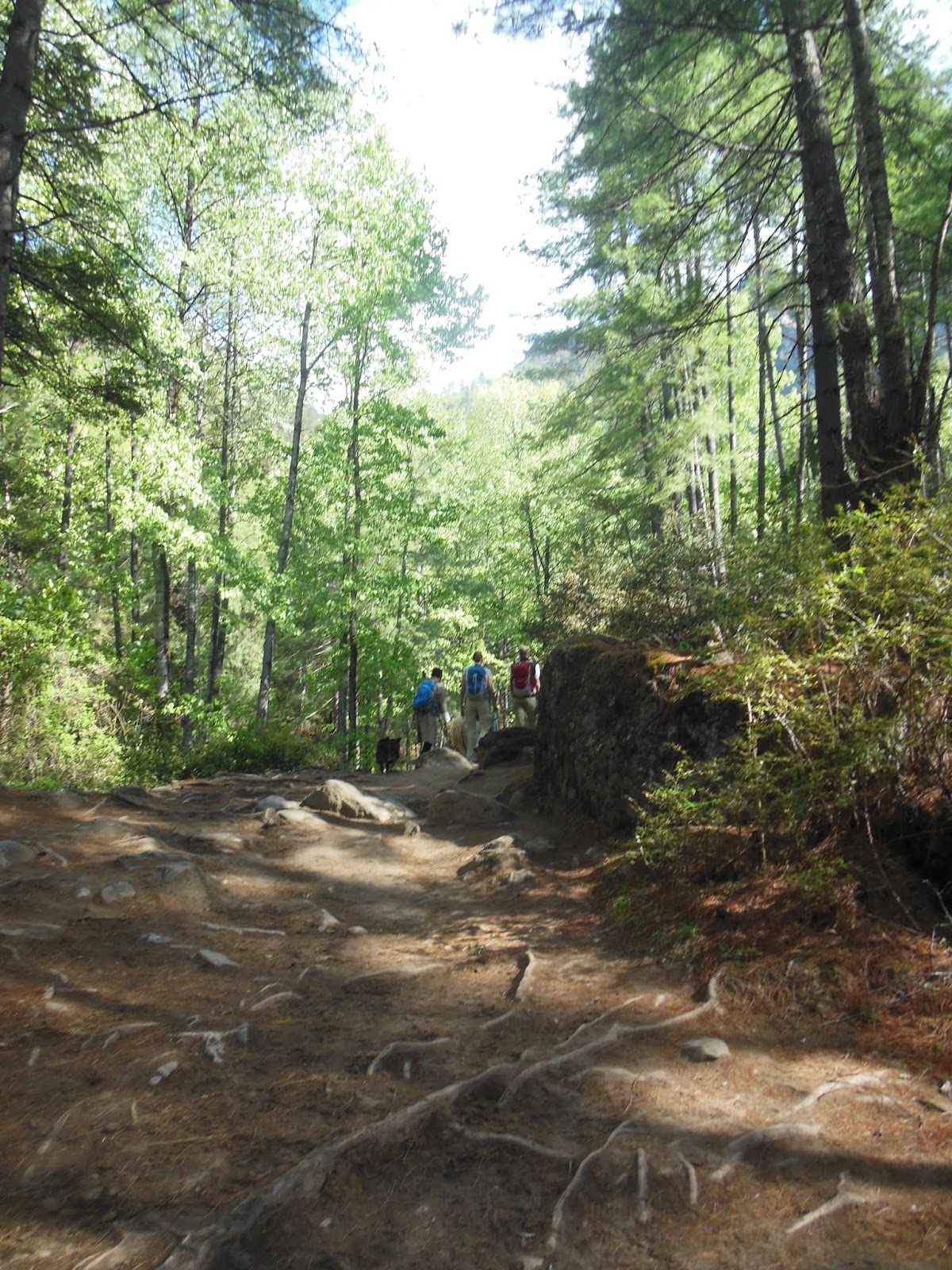
On the trek trail...with a lot of tree cover...
So SERENE...One can really feel the SERENITY
as you keep trekking...
Enjoy the trek trail as you see lovely Rhododendron trees
in bloom on the trek trail....

Halfway

At the halfway mark, we were told that a one minute walk down would take us to a tea stop if we needed a rest, but we decide to continue on and stop on the way back to beat the afternoon heat and also the unpredictable Himalayan weather as we were exposed to Thunderstorms and rain the previous days. 

And there is the Halfway mark..and you can see the Tiger's Nest temple
in the background..but still a long way to go...
One of the Nature Sign Posts along the way...
Keep climbing...
You keep continuing uphill, and you are periodically teased by glimpses of TATKSANG coming closer and looking more beautiful. 
Almost 3/4 th of way up done..but yes...
still some way to go...
Me and my 11 year old group mate who kept
me company for the entire trek...
Finally, just when you feel you have more or less reached the top be prepared for some REAL THRILL. You are greeted by the most STUNNING VIEW YET - a set of stairs heading down leading to a sacred waterfall, after which the stairs wind up again to the wooden gate of the Tiger's Nest (according to locals around 700 stairs or so). 
A glimpse of the sacred waterfall in between the up
and down stair climb...

Beautiful view of Paro Valley from the
View Point which is on the way
At the gate, one can see lot of prayer flags hung across and as they blow in the Himalayan Breeze, one can feel the timelessness and sanctity of this cliff-side temple. You have to remove your footwear before entering the temple. 
Prayer Flags along the way...
Inside the temple, we hired a guide to walk us through the various cave like shrines, including the cave where Padmasambhava is supposed to have meditated. We lighted yak butter candles and spent about 45 minutes to an hour before preparing ourselves for the climb back down.

The Return Journey

The return journey is much faster but equally dramatic what with the stair climbing sequence now REVERSED. You will find lot of local people and tourists on the way, who will keep cheering you and encouraging you to keep walking.
Another beautiful view of the Paro Valley
from the View Point
There is only one restaurant situated mid-way and the pricing of eatables available is on the expensive side. There is also a souvenir shop in this area in case one needs to purchase some souvenirs.
Prayer Wheels on the way....such an important part
of the Buddhist Tradition
In speaking with the local people/guides on the way, we were told that in all there are some 700/800 or more stairs leading up to the monastery gate. Side-railings have been put up on the entire stair-case route leading up to the monastery. Once you reach the gate, you have to hand over your wallets, cameras etc at the gate counter. Please note that in Bhutan there is a dress code to be followed especially while visiting religious places. Photography is prohibited inside the Temple. There is also a small area where you can refill your water bottles with some pure water. 

The monastery caught fire in 1998 possibly from butter lamps but was restored to its former glory.

About two hours uphill, an hour spent inside the monastery and about 2 hours downhill including a brief stop at the cafeteria, I along with some of my group managed to reach the base by 1-1:30 pm.


There is a small handicraft market area at the basement from where you can buy jewellery and other craft items. 


Trek done and pleased, I got into our bus which was waiting for us and waited for the other group members to finish and join us. Finally about an hour or so later the remaining group members arrived and as soon as they entered the bus, we were greeted by thunderstorms and rains. We were relieved to be back in the comfort of the bus and headed back to the place where we were put up, where a well deserved late lunch was awaiting us.

The Tiger's Nest Trek is normally scheduled somewhere mid-way or towards the end of any Bhutan tour to allow time for people to acclimatize to the altitude and weather in Bhutan.


Hanging suspended in the air as if they are reaching towards GOD, these monasteries serve to prove that a quest for silence, serenity and inner peace can be so great as to drive humans to build these amazing Castles in the Air.





Thursday, 7 June 2018

Kashmir Diaries : Trek to Hari Parbhat - A fort steeped in History (April 2016)

Kashmir Diaries : Trek to Hari Parbhat  

One of the very beautiful highlights of our Kashmir Trip in April 2016 was a visit to Badaam Wari(Almond Garden) in Srinagar, Kashmir, which rests in the foothills of Koh-E-Maran. This 300 kanal garden is dotted with trees, flowers and cascades which turn it into a beautiful and soothing sight.
Entry gate of Badaam Wari or The Almond Garden
This is another beautiful offbeat place in Kashmir and it is relatively less crowded compared to the other hot destinations like the various Mughal Gardens. So you can relax and enjoy this place to the fullest. Thousands of Almond trees grow all over Kashmir and for the local people the blooming of almond flowers indicate the onset of spring. The Almonds from these gardens are known for their superior taste and high quality.
Group Click at Badaam Wari with
 part of our group
Badaam Wari done, and loads of pics taken, we decided to check out the possibility of trekking the Hari Parbhat fort which was very close-by.
One of the sign posts on the way...
This fort is currently occupied by the army and tourists need to get entry permit from the Archeological Department's office at Lal Mandi in Srinagar to visit this fort. We were lucky that this fort was open at the time we went as many a time and for many years this fort has been closed to the public due to security reasons. So when we got to know that the fort visit was open for the day, the trekkers in our group immediately decided to jump in on this opportunity to trek this fort, as opportunities such as these are rare and not to miss and having come from so far and given the security situation in Kashmir.

Hari Parbhat Fort - History
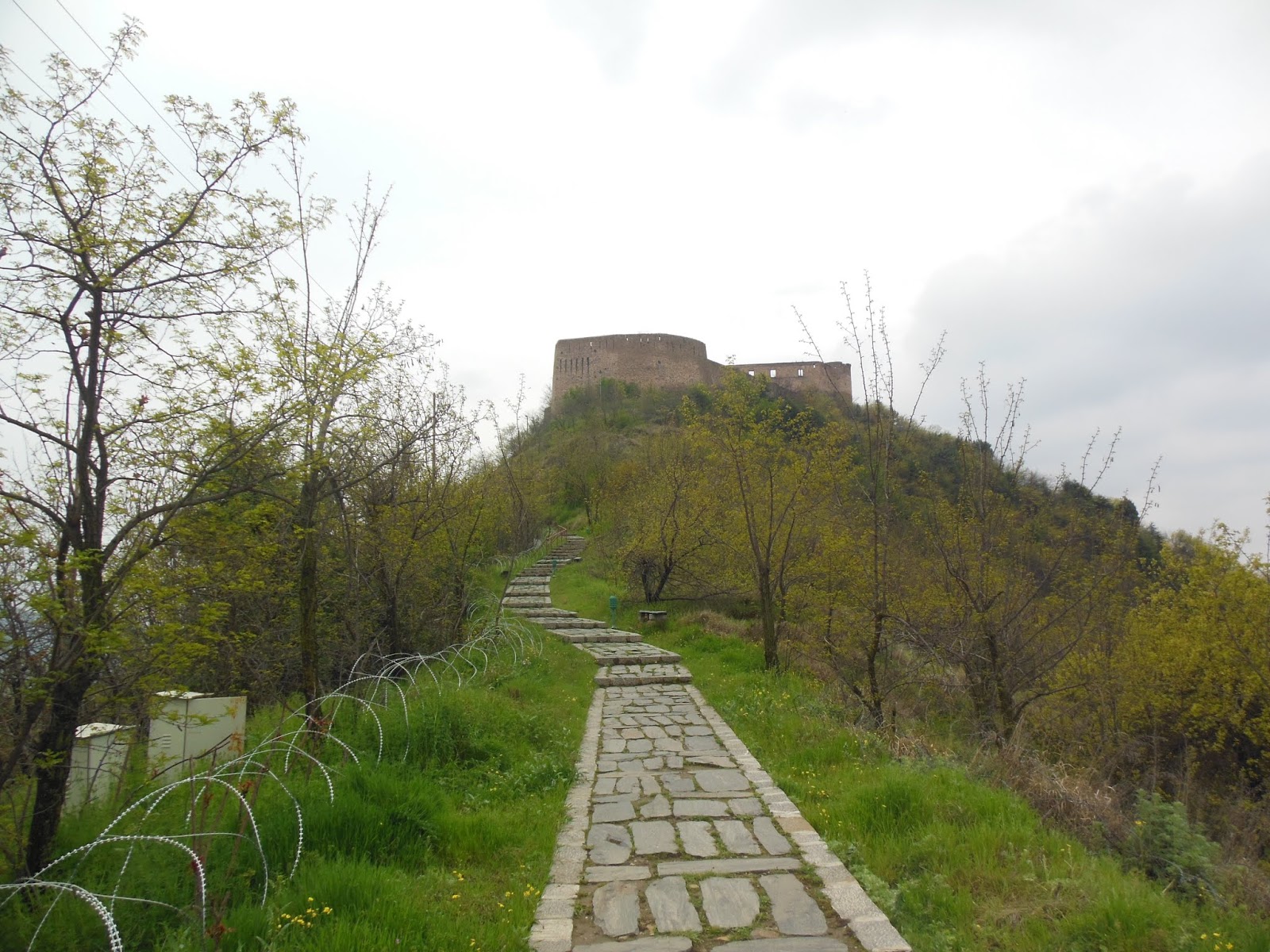
And  you can see the Hari Parbhat fort clearly in view..
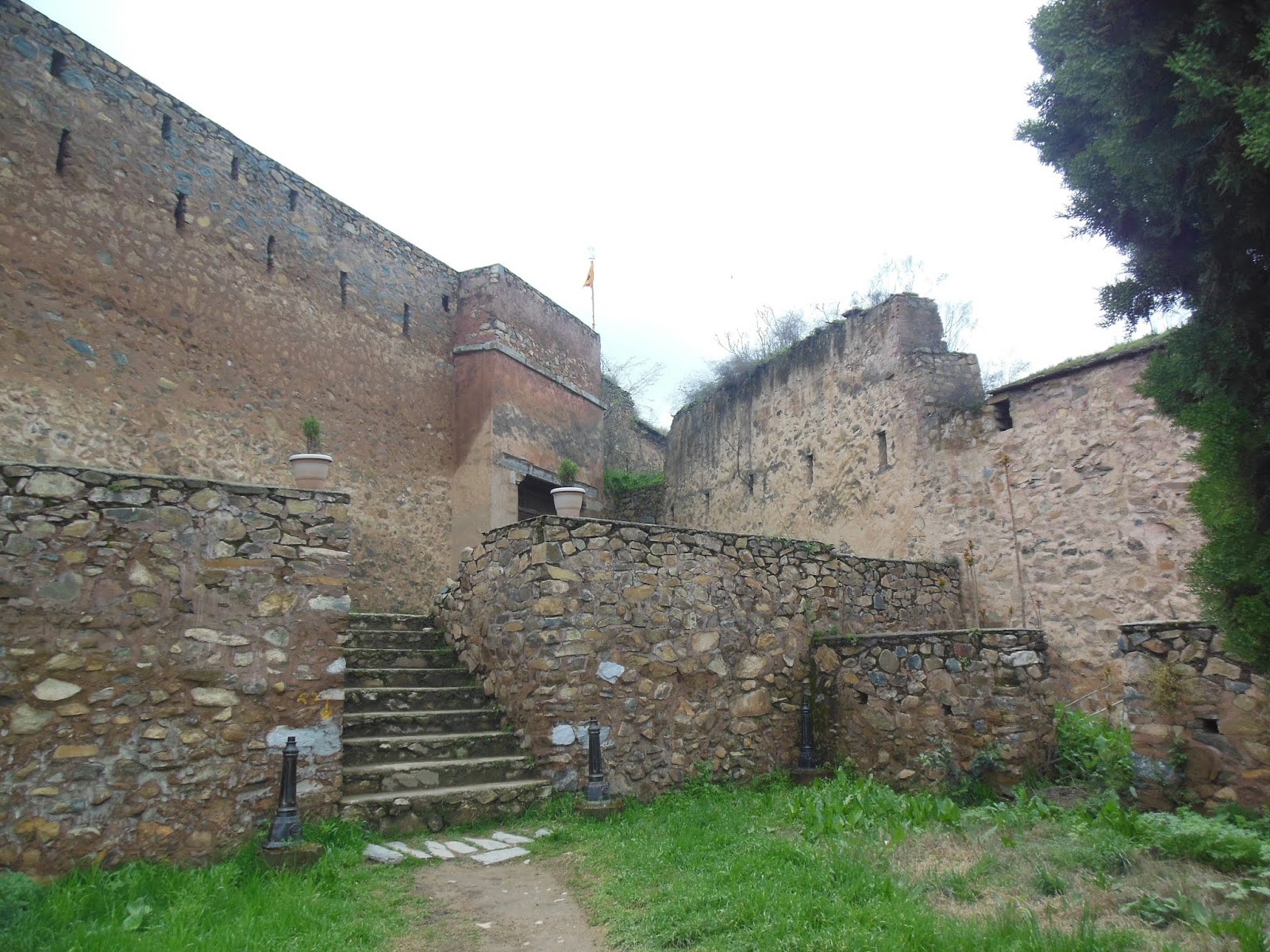
Hari Parbhat is the only surviving fort in the Kashmir region of the state of Jammu & Kashmir. It stands over a hill also known as Koh-I-Maran and originally was a site of a fort built by Emperor Akbar. He had also built a large fortification wall at the base of the Hill, parts of which survive even today. The present structure was built by the Afghans, when Kashmir was part of the Afghan Durani Empire under Shah Shuja Durani. Ironically, Shah Shuja Durani was himself held prisoner in the fort by the Governor of Kashmir, Atta Muhammed Khan. Atta Muhammed Khan had invited Shah Shuja to come to Kashmir from where he could still go on ruling as the King of Afghanistan. Shah Shuja took up the offer only to find himself as Atta Muhammed Khan's prisoner at the Hari Parbhat fort. However a force of Durani Afghans in alliance with the Sikhs of Maharaja Ranjit Singh landed in Kashmir soon and the Sikhs got Shah Shuja Durani free from his prison inside the Hari Parbhat fort. The Sikh flag of Maharaja Ranjit Singh finally flew over the Hari Parbhat fort when the Sikhs under the able leadership of Gen. Hari Singh Malwa finally defeated the Afghans in 1820. After a brief rule of Sikh rule in Kashmir the fort changed hands and landed in the hands of the Dogras led by Raja Gulab Singh after the Sikh loss in the First Anglo Sikh war of 1846. The Dogra rule lasted for about 100 years and in 1947 it became part of India and since then the fort has been occupied by the Security Forces.

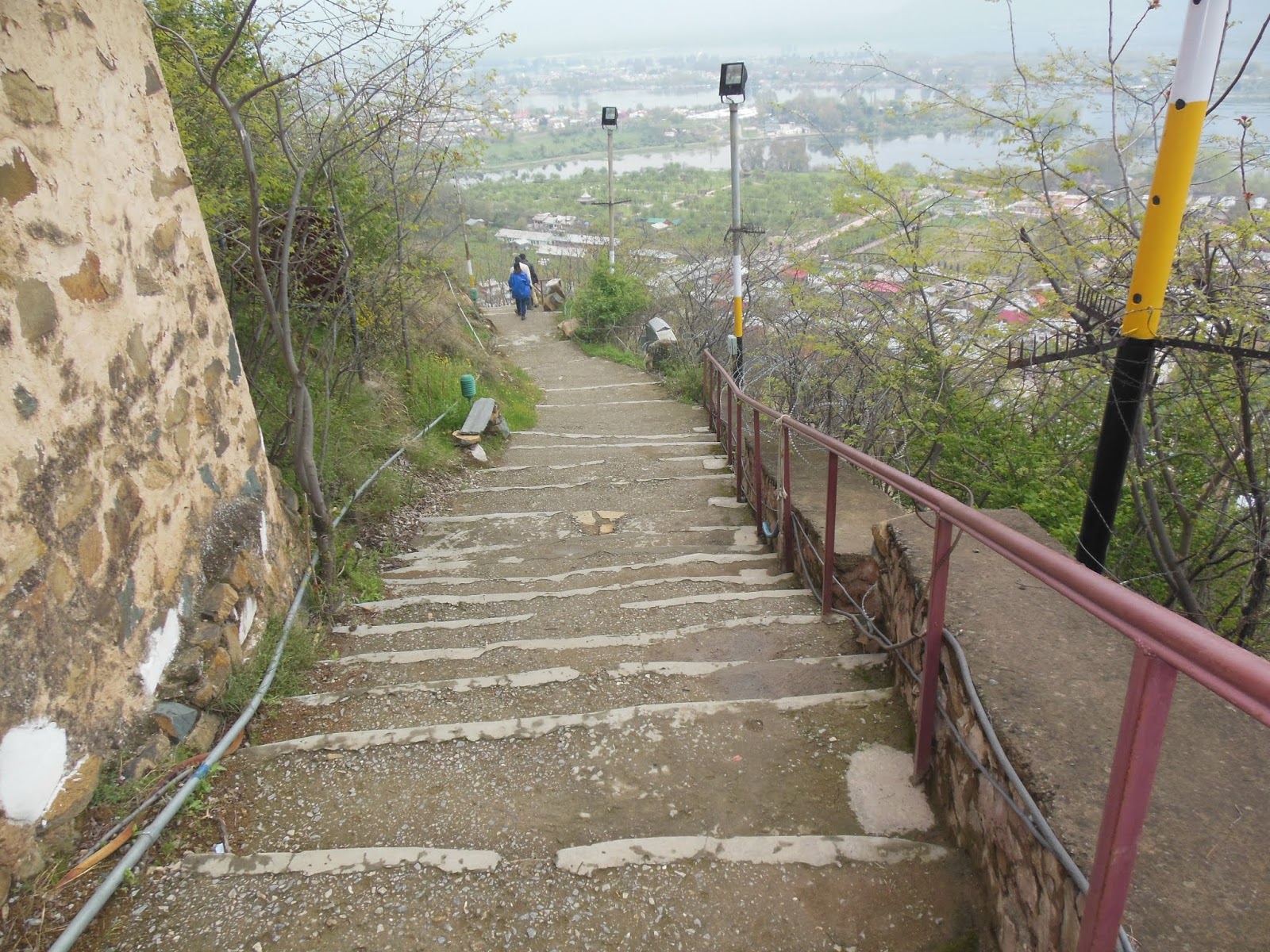
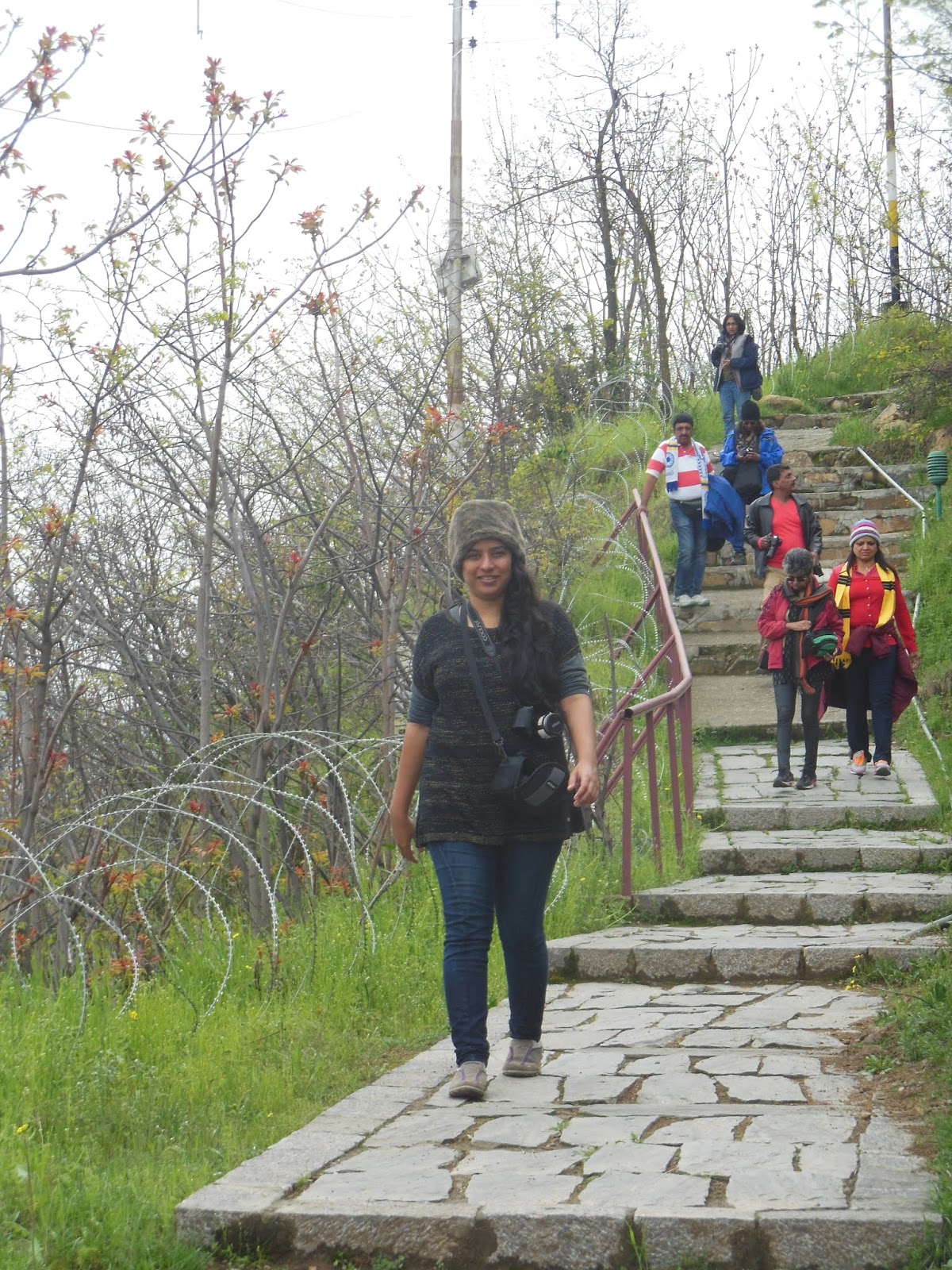
It is a lovely trek, about 1 km uphill and not too strenuous with some amazing views of Srinagar on the way to the top.

On the way up...
This fort still stands as proud as ever on the vantage point overlooking the Srinagar City.
An amazing view of Srinagar on the trek trail
An inside view of the Hari Parbhat fort...
A view of Srinagar through the Barricades...
The fort Hillside holds some important places of worship for various religious inclinations. There is the shrine of Makhroom Sahib, a saint held in great reverence by the Kashmiri Muslims. There is the Shakira Devi Mandir, who is worshipped as an Incarnation of SHAKTI. Then there is the Chati Padshahi Gurudwara, where the sixth Guru, Guru HarGobind had supposedly preached and stayed for a few days during a visit to Kashmir.
Another view of Srinagar
with a part of the Shakira Temple in view
On the Trek Trail
Trek Trail on our way back...

And our trek ends...
Hari Parbhat stands as a SENTINEL which silently watches over the myriads of events which have happened in this troubled land over the years.
A view from inside the fort...

And it still keeps watching....with the MIGHTY PIR PANJALS in the background.


Thursday, 10 May 2018

Trekking in Kashmir - Offbeat Yusmarg (April 2016)

About Yusmarg
Scenic Yusmarg
There are a couple of legends surrounding the origins of Yusmarg’s name. One hints at ‘Yusmarg’ being a corruption of ‘Roosmarg’, or ‘meadow of the musk deer’. Another one comes from a belief that Jesus Christ spent some of his ‘lost’ years in India, and passed 
through Yusmarg, earning it the name ‘Meadow of Jesus’. It is believed by the natives that Jesus came to Kashmir and stayed at Yusmarg for some time. Located at an altitude of 2396 meters above sea level and set amidst the pristine woods and gorgeous panoramic vistas, this place reminds you of the painting you would have done as a kid in school. 
So Picturesque - Ideal for a painting. Lovely
cottages set amidst the meadows.
The drive to this place takes one thru breathtaking vistas being flanked by the orchards of apples, peaches and almonds.  It is an alpine valley covered with snow clad mountains and the meadows of Pine and Fir and located in the Pir Panjal Peaks, a sub range of Himalaya. It is situated at the bank of Doodhganga River which is a tributary of Jhelum River.

An Offbeat place away from the usual commercial touristy spots

This place looks pristine, hidden and unspoilt from commercial tourism. One can hardly spot any crowd here and there is only one restaurant in Yusmarg managed by the Jammu and Kashmir tourism department. 
The only restaurant built by the J&K tourism department
The Jammu and Kashmir tourist department has built lovely cottages on these meadows. In 2017, I had the opportunity to visit Scotland and Bhutan as part of my travels, and somehow, the beauty of both these places reminded me a bit about Kashmir. However its not fair to do comparisons as each place has its own unique beauty in different seasons and has its own culture.  
Lovely cottages dotted along the meadows.
My earlier visit to Srinagar as part of my Ladakh tour in July 2013 got curtailed due to a sudden civil unrest in the region and our entire group got caught in curfew and so we could do only a limited sightseeing in Srinagar in the evening after sunset for 3-4 hours when the curfew was relaxed. Luckily this was in the fag end of our main Ladakh tour which went off very well otherwise. So when I got an opportunity to do a full Kashmir tour in April 2016, which included Sonamarg, Gulmarg, Yusmarg, Srinagar etc , I opted for it.  

It was a rainy and misty trek for us at Yusmarg

After couple of hours of scenic ride by bus from Srinagar, we reached Yusmarg by 11 am. As part of the initial itinerary, we had planned on doing the Doodhganga trek also which is barely 2 km to the west of Yusmarg, and is a fast-flowing river named after the water that churns into froth when passing over rocks and an ideal picnic spot too. But as it was raining incessantly that day and so we decided to trek somewhere more close by. Actually it was an ideal day to sit inside cozily with such a scenic view around and just enjoy tea and other refreshments. And so though it was raining heavily, the trekkers in our group  decided to explore the place a little more while the others waited at the only Jammu and Kashmir tourist restaurant in Yusmarg having their tea and snacks. 
Our group taking in the beautiful vistas at Yusmarg
As we stepped outside the restaurant, we could see a few horses/ponies and their handlers waiting outside and pleading with us, the visitors, to take a pony ride. They are Gujjars - a nomadic community in the Himalayas who live in the mountains and rear sheep. During winters they migrate to the villages and in the summers they go back to the mountains. We were not inclined towards taking a pony ride but we decided to engage the services of the handler to lead us on a short trek thru the meadows. So it was the pony, the handler and seven of us who decided to explore this place a little more. 
Our Trek Leader(s) for the day

On the Trek Trail in Yusmarg
Part of the Trek Trail, with streams flowing..
On our trek path in Yusmarg 
One of our team members posing with a Gujjar..a really
misty and scenic day at Yusmarg

 
Oh..it's so misty..amazing vistas at Yusmarg...

On our trek trail...Sheeps grazing in Yusmarg..

On our trek trail..lovely Gujjar Girls posing for us
Loved the rainy and cold trek here in the middle of beautiful meadows with ponies grazing, crossing streams, slush etc due to rains, not to forget the hot tea that we had after the trek at the only restaurant here. But we had to cut short our trek due to incessant rains and didn't want to keep the other group members waiting endlessly for us. So we returned to the restaurant for tea and snacks which we relished more in the cold weather. After that we decided to head back to the bus and back to Srinagar where we were put up for the night.

On our way back we stopped by to click some beautiful pictures along the way of 
shepherds handling their flock of sheep.
The Sheep and their handler - They are Gujjars who
are a nomadic community.
The sheep and their handler..another shepherd
 handling his flock...amazing sights along the way at Yusmarg
We also stopped by to greet a group of Kashmiri children who were going to school. We asked them if we could take their snaps and they happily obliged and were also very happy to receive the chocolates we gave them in return.
These lovely school kids were as excited to see us, as
we were to see them
Lovely school kids posing for us on our way back..
and they loved the chocolates that we gave them in return
And thus ended one more of my lovely and scenic treks with amazing vistas and great memories to cherish for a long time...Happy Trekking...!!

Tip for my trek buddies : If you are planning a trip to Kashmir make sure to include this place in your itinerary.  YUSMARG IS A TREKKER'S PARADISE.

Monday, 7 May 2018

A Monsoon Night Jungle Trek, A Walk in the Clouds & A Fireflies Show - June 2015


Late Blog....
If the Monsoons are here can trekking be far behind! Ah...we not only love the rains so much but trekking in the rains as well! Sharing experiences from my Rajmachi Trek done in June 2015.

About the Place 
Rajmachi (Udhewadi) is a small village in the rugged mountains of Sahyadris in India and falls between Lonavala and Karjat. It can be reached from either places. The fortification at Rajmachi consists of the twin forts, namely Shreevardhan fort and Manaranjan Fort. There are many trek routes one can take to reach Rajmachi and depending on the route taken the trek duration can range from 4 hours to 6 hours. We took the shorter but arduous route which involves a steep climb via the Kondane Caves passing thru dense forests.
Monsoon Vistas..Clouds gather along the way to Rajmachi
Local Travel 
Part of the team met at CST and took the fast train from CST to Karjat where the entire team met. Some group members joined us in the train from various other stations as per their convenience.The train was jam packed that day and the other passengers were venting out their anger on us as we had our bagpacks with us and the train was too crowded that day. People from Mumbai who travel often in trains can relate to this scene. Once we reached Karjat, which was a great relief from the maddening crowded train, we took the local transport (local rickshaw) to get to the Base Village, Kondivide. As soon as we sat in the rickshaw the rains started splashing and the first rains are always an amazing experience where you see the greenery start to come alive. At Kondivide village we had our tea and refreshments and after that the usual round of introduction of the entire team. In all we
were around 60 trekkers. Tea, Refreshments and Introductions done, we started our trek to Kondane Caves thru the wilderness.
After Tea and Refreshments the customary Group Introduction Round

Trekking our way to Rajmachi
A glimpse of the trekking route
Reaching Rajmachi via Kondane Caves
It takes 3 hours to reach Rajmachi or Udhewadi village from the base village. It is advisable to carry 2-3 litres of driking water per person. In all we had three stopovers, the first being the beautiful and serene Kondane Caves located in a small village, Kondana, between Lonavala and Karla Caves. The caves were excavated in first century B.C. Took a break here and spent time here for some photo-ops. We started our trek again and as we approached darkness we were stopped in our tracks by tiny yellow lights blinking over our heads and as we reached a clearing we could see thousands of fireflies fluttering above.

A glimpse of Kondane Buddhist Caves, our first stopover
Another Glimpse of Kondane Caves
 
Nice  photo-op at the Kondane Caves

Heading towards Rajmachi
The Fireflies Show 
One of the main added attractions of Rajmachi is the fireflies show that you get to witness in the dark dense jungle. Its like an open air theater and feels like hundreds of small search lights popping out of the trees. Could also see some fireflies hovering above our heads and it feels like a small shooting star zooming over you. Its a must watch, but this phenomenon happens only during the pre-monsoon period. Best time is from June 1-15 before monsoon deepens. Make sure to put off your torches to get the best view (that's why I don't have a fireflies show pic as even cameras can spoil the show). I guess we went at the right time as the monsoon had just started and the weather was extremely pleasant for trekking and we could see the fireflies show as well. Probably a week later and we would have missed the fireflies show. But as the monsoon advances one can get to see awesome waterfalls. We reached Rajmachi at 9:30 pm. We also had a birthday celebration for a fellow trekker and that went past midnight.
Beautiful views along the way....


Night Jungle Trek 
An awesome experience trekking in the night thru dense forests with only searchlights..it is quite thrilling and exciting...should say, made me a fan of night treks.

Food & Camping at the base village 
Enjoyed the dormitory type camping experience and the food was APRATEEM(too yummy).  We were treated to some awesome Kande Pohe and Chai for snacks and an equally yummy Thali food for dinner. Typical yummy village food and that too in the rains....a perfect combination! We slept only for a few hours after midnight before we were woken up by our trek lead again at 5:00 am.

Kande Pohe and Chai time at the Base Village...Yummy! Yummy!!
Beautiful lake near the base village...beautiful views along the way...
A Walk in the Clouds to Shreevardhan Fort 
Next day we all got up by 5am and freshened up a bit before starting our trek from Rajmachi to Shreevardhan fort by 5:30am. The early morning trek from Rajmachi to the top of Shreevardhan Fort turned out to be a WALK IN THE CLOUDS. Perfect weather. Superb experience. We skipped Manaranjan fort. Reached the Shreevardhan top by 6:30am. View from the top was awe inspiring.
We could locate Lonavala, Pawna Dam and The Duke's Nose from the top.  By the time we descended we were engulfed in fog and it drizzled a bit every now and then. After a breakfast of Pohe along with Chai, we took leave and started our descent from Rajmachi. An appetizing lunch awaited us at Kondivide Village. Post lunch we started our trip back to Mumbai.

And there is The Dukes Nose, a favorite rapelling point with Trekkers.
View of Rajmachi from Shreevardhan Fort
On top of the Shreevardhan Fort! What a View!!
Clouds begin to envelop the Mountains..View from Shreevardhan fort..Amazing vistas...!!
Group click on top of the Shreevardhan Fort!!
And Finally the Grand Group Click..after the Trek!! Happy Trekking!!

A Monsoon Night Jungle Trek, A Walk in the Clouds in the Sahyadris and a Fireflies show. Can a trekking experience get any better...Happy Trekking....:)

  WHAT'S IN BEAUTY I stared with a glance At the mirror in the wall There wasn't any chance Of any fault at all. Then I had a second...